This post is adapted from an article I wrote for the Royal BC Museum’s online publication Curious, no. 3 (Summer 2014).
Music: “Mi Bolero,” composed and performed by Maarten Schellekens.
Motion picture film provides a record of passing time, rendered as a series of still pictures on a length of film stock. After the advent of sound, commercial movies ran at a constant speed, dividing a second of movement into exactly 24 frames. But this was not always the case. In the silent film era, cinematographers hand-cranked their cameras in a personal rhythm, often cranking slower or faster to adjust for lighting conditions. When these films are shown at sound speed today, the speed mismatch often produces the inadvertently comic “jerkiness” that many viewers associate with old movies. The “correct” speed for such footage has to be determined through trial and error.
Film is also an artifact of time—often a fragile one, whose blemishes, splices, technical imperfections and signs of wear reflect its age and history of use. The first Comox scenes in the clip featured above show the ravages of nitrate decomposition: a chemical process that affects the nitrocellulose base of the film stock, damaging and eventually destroying the image itself. In another shot from the clip (at 2:29 – 2:39), static electricity (acting on the film stock before it was processed) has left dancing white lines within the image, creating an effect that looks like rainfall.
The renowned film historian Kevin Brownlow has written that documentary films “can be transformed by the passage of time into priceless relics that recapture our past in an astonishingly vivid manner.” That is certainly the case with the footage shown here.
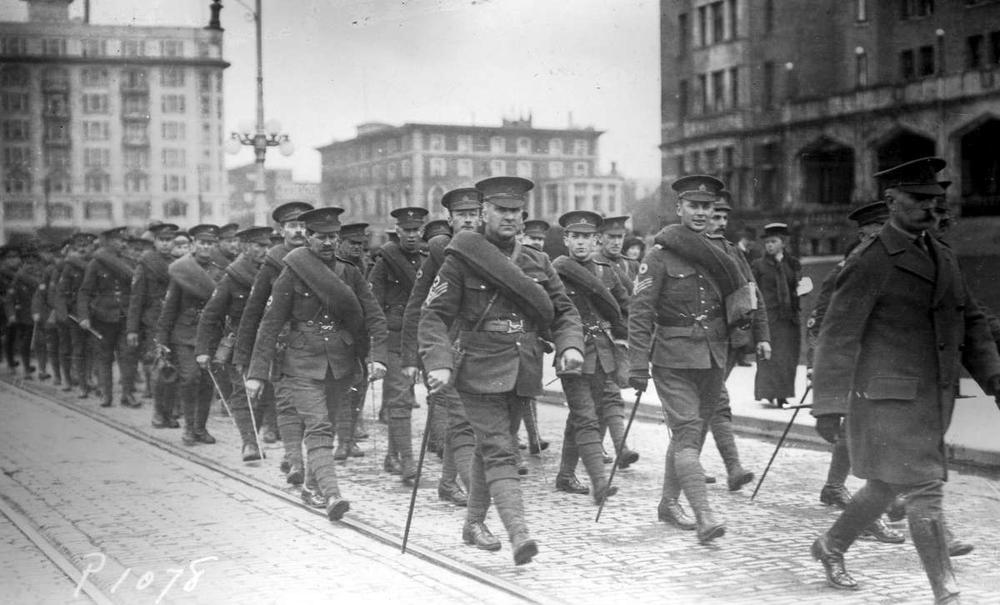
This clip is a video montage, compiled from film footage shot over a century ago. It was one of four such montages in the video presentation Answering the Call, which were part of a 2014 Royal BC Museum display commemorating the Great War. The presentation drew on almost an hour of rare film footage shot in BC during the First World War. This material shows troops in training at Comox, Vancouver, and Victoria, Comox, before their departure for eastern Canada, England, and the battlefields of Europe.
Eight of the ten source reels used in the presentation depict events in Victoria. This material exists as raw, unedited footage, with few details about dates, events or units depicted. It owes its survival to Allan D. Taylor (1916-1999), a Victoria film enthusiast, who donated his unique collection of BC footage to Library and Archives Canada in 1973.
More details are known about the other two source reels. The Comox and Vancouver items were both shot by pioneering BC filmmaker A.D. “Cowboy” Kean (1882-1961). Kean attempted to document every unit that left the province to serve in the Great War. In February 1916, he screened a four-reel compilation of this material in Vancouver, under the title BC for the Empire. Like most of Kean’s film productions, however, this early documentary has vanished. The extant examples of his military newsreels show two specific BC units: the 102nd (North British Columbians) Battalion at Goose Spit near Comox, and “D” Company of the 196th (Western Universities) Battalion in Vancouver.
The men of the 102nd are shown in camp at the beginning of this clip, then marching along the beach and through Comox. (0:10-1:26) This is followed by footage of “D” Company of the 196th, marching down a ramp (from Cordova Street?) and onto the platform of the CPR station on the Vancouver waterfront. (1:26-2:06) The remainder of the clip comprises scenes from Victoria, intercut with another piece of the Vancouver footage.
One problem with the Victoria films is that they have no particular order or structure. Some shots are much too brief, and some run on at great length; some are repeated, and some are truncated before the action shown is completed. In creating the video presentation, the challenge has been to emphasize the most interesting footage, and to construct a meaningful visual story. Where possible, image flaws were edited out or adjusted, and obvious speed issues were corrected.
The selected images have a remarkable quality of immediacy—even more so than still photographs. We watch these BC recruits as they prepare to go to war; we can see them marching, drilling, standing at attention, and relaxing in camp. They come to life on the screen.
This footage provides valuable visual evidence of a critical time in British Columbia’s history. It is also a poignant record of young men who saw the Great War as a great adventure. Their moving forms are an eloquent reminder of their youth, service, and sacrifice.
Waving their hats jubilantly, a group of recruits (from “D” Company of the 196th Battalion) offers up three cheers. In a column of men marching along Victoria’s Belleville Street, one figure is shadowed by a small child who clings to his hand. On the pier gangway, a soldier pauses to shake hands with the military cadets standing guard. As a steamship eases out into the Inner Harbour, its deck and rigging are crowded with uniformed men, all waving farewell to the crowd on the dock. The footage may be silent, but their faces, turned towards the camera, still speak volumes—even a century later.
=======
The music featured in the above video clip is “Mi Bolero,” composed and performed by Maarten Schellekens. It has been shortened to fit the video. It is licensed through FreeMusicArchive under an Attribution-NonCommercial 4.0 International License.


 Seriously Moving Images
Leave a comment