by Dennis J. Duffy
Out of the Shadows
Lew Parry Film Productions, 1958, for the Salvation Army Harbour Light Corps
26:26 : 1 reel, sound, b&w; 16mm
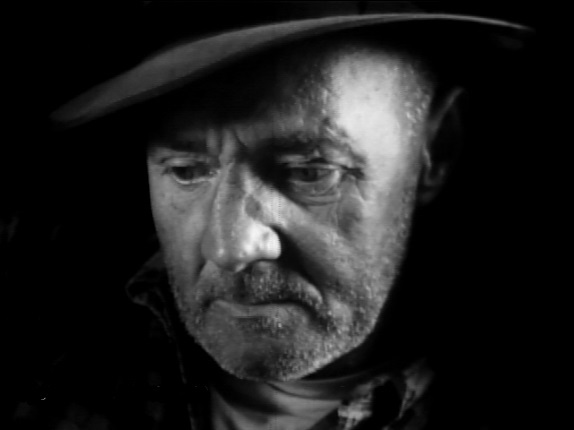
This poignant documentary film depicts the daily experience of a homeless alcoholic on the streets of Vancouver’s Downtown Eastside, and his eventual reintegration into society through the services of the Harbour Light Corps of the Salvation Army.[1]
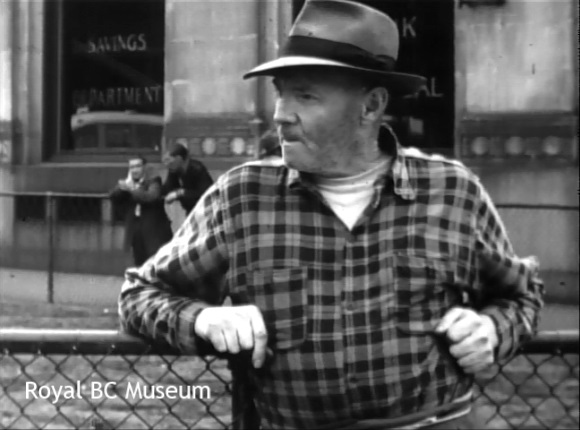
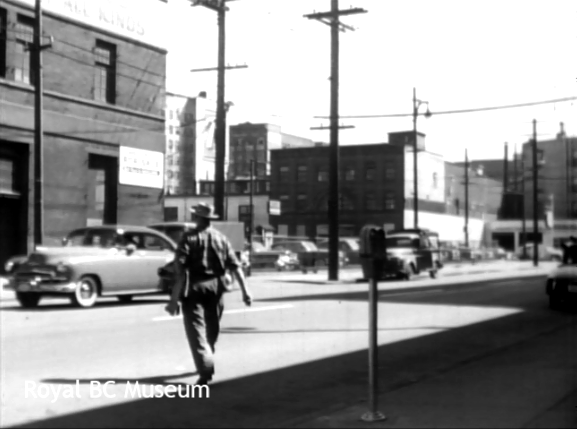
The City of Shadows. The first half of the film shows the man’s day-to-day existence on the streets of Skid Row: loitering, panhandling, drinking non-potable alcohol, sleeping rough, and finally passing out in an alley. The second half shows his growing awareness of his condition, his struggle to give up alcohol and regain his self-respect, his acceptance of help from the Harbour Light, and his newfound faith.
Out of the Shadows has several remarkable elements.
- The unnamed central character is not played by an actor, but (apparently) by an actual recovered alcoholic, re-enacting scenes from his own life.[2]
- Seen first in his new job as a commissionaire at Vancouver Airport, he then recalls his story in an extended flashback. The first-person narration, written by journalist Reginald M. Dagg and spoken by Vancouver actor Walter Marsh (uncredited), is dramatic and compassionate, yet entirely believable as coming from the protagonist.
- The film was shot on location in the streets of Vancouver, stressing the seamier aspect of the city.[3]
- The black-and-white cinematography, mainly using available light, emphasizes darkness and shadow. In one scene, a handheld camera is used to provide a subjective view of the protagonist’s staggering drunkenness. (Strangely, no cinematographer is named in the credits. Was it Parry himself?)
Many of the above elements – the use of flashbacks, first-person narration, location shooting, an urban setting, and of course black-and-white film – are also key characteristics of film noir, the cycle of darkly poetic crime dramas made in America during the 1940s and 1950s.[4]
Were producer Lew Parry, director Bert Pullinger, and writer Reg Dagg consciously influenced by film noir? That might be overstating the case. Nevertheless, it’s quite true that Out of the Shadows is markedly different from any other film that Parry produced. His legacy as BC’s most prolific filmmaker rests on 30 years of sponsored industrial films – competently made, straightforward, and mostly impersonal. And Bert Pullinger made so many films for the BC forest industry that Parry dubbed him “Cecil B. DeSawmille.”
This is also Canada, my friend. Out of the Shadows probably owes much to another Vancouver film: the CBC documentary Skidrow, directed by Allan King and written by Ben Maartman, which was broadcast nationally in early 1957. It shares the setting of Shadows, and many of the same cinematic qualities – as well as its insight and compassion – and is one of the best Canadian films of its time. But Skidrow is also unremittingly bleak, and its third-person narration allows us to stand outside the lives of its derelict subjects, who are portrayed as men utterly without hope. The Salvation Army’s presence is presented as charitable and well-meaning, but largely ineffectual.
The subject matter was not a popular choice, either. When Skidrow was submitted to the Prix Italia broadcast film competition, a small-minded editorial in the Vancouver Sun questioned whether “Canadian cultural interests require CBC to show this city to Europe as a collection of drunks sleeping in doorways.”[5]
However, the stark realities of life on the Downtown Eastside have often captured the attention of writers and artists. Malcolm Lowry described the area memorably in a powerful poem — a sonnet, in fact — written just after the Second World War. It’s called “Christ Walks In This Infernal District Too.”
Beneath the Malebolge lies Hastings Street,
The province of the pimp upon his beat,
Where each in his little world of drugs or crime
Drifts hopelessly, or hopeful, begs a dime
Wherewith to purchase half a pint of piss –
Although he will be cheated, even in this.I hope, although I doubt it, God knows
This place where chancres blossom like the rose,
For on each face is such a hard despair
That nothing like a grief could enter there.
And on this scene from all excuse exempt,
The mountains gaze in absolute contempt,
Yet this is also Canada, my friend,
Yours to absolve of ruin, or make an end. [6]
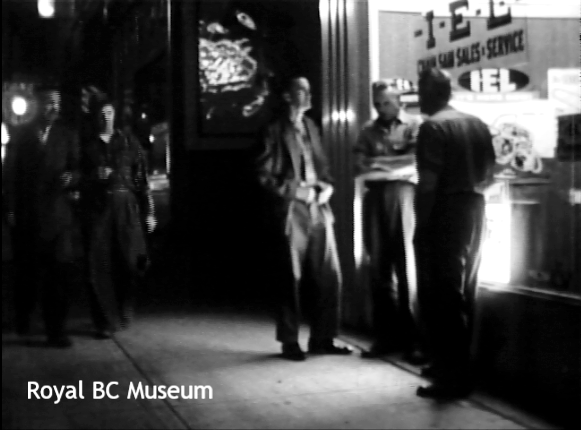
A Path from the Shadows. On the other hand, Out of the Shadows offers the hope of recovery and self-redemption, and demonstrates that they are possible. This important difference is no doubt due to the fact that the Salvation Army wanted to use Shadows as an educational and fund-raising tool. In place of the unwavering documentary eye of Skidrow and Lowry’s poem, Out of the Shadows maps a narrow path out of its urban Hell.
The first half of Shadows ends with the protagonist passing out in an alley, where he is found by the Vancouver City Police. We pick up the story the next morning, in the continuing flashback: he wakes up in jail and discovers that he has lost more than he realized. As he says, “This time it was different.” In ensuing scenes, we’re shown his growing awareness of his condition, his acceptance of help from the Harbour Light Corps, his efforts to regain his confidence and self-respect, and his newfound faith.
As its title indicates, Out of the Shadows offers the hope of recovery. It does so in a non-judgmental way, offering understanding and compassion to the men of the Skid Road. The tone is not overtly “preachy,” and the steps our hero takes are practical ones, supported by his religious beliefs.
This part of the film has several memorable scenes. The protagonist’s realization that he has “really hit bottom” is captured in eloquent close-ups. His restless wanderings on the city streets are depicted in a very evocative manner. His two encounters with the pump organ, showing music as something that has left him, “along with everything else” — but which can ultimately be regained — provide a powerful metaphor for his condition. The narrator’s simple statement, “And this was my room,” underscores a poignant scene handled with restraint. The sudden appearance of “temptation” (a proffered drink of rubbing alcohol), and the decision to walk away from it, give the story its quiet climax.
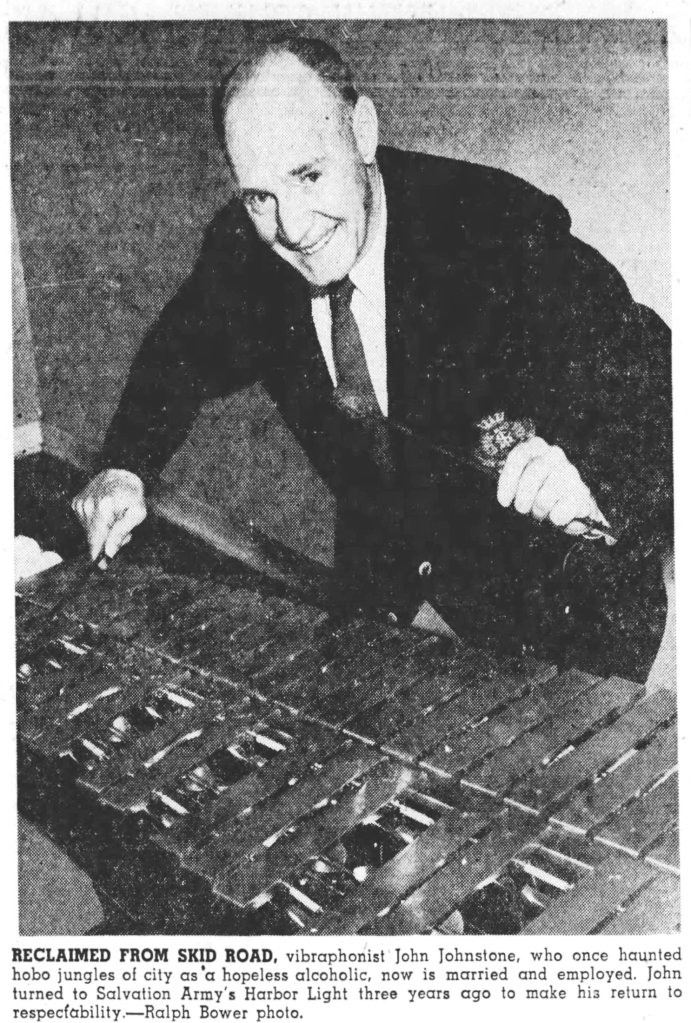
Parry’s film was inspired by Simma Holt’s profile of the central character, musician John Johnstone, which appeared as a Community Chest feature about the Harbour Light, published in the Vancouver Sun on 21 June 1957.
[1] The usage of “Downtown Eastside” to denote the blighted Vancouver neighbourhood centred on Main and Hastings seems to date from the late 1960s. In earlier decades, the area was known as the city’s “Skid Road” or “Skid Row.” The social problems connoted by that label began before Prohibition, and were exacerbated by the Great Depression, the Japanese-Canadian internment, and many other factors. See “Downtown Eastside” and “Skid row: Vancouver” in Wikipedia; retrieved 8 January 2017.
[2] Simma Holt, “‘Harbor Light’ Aids Escape from Jungle,” Vancouver Sun, 21 June 1957, p. 3; “Skid Road Story Put in Films,” Vancouver Sun, 14 February 1958, p. 29.
[3] The environs shown in the film are very familiar: Victory Square (“Pigeon Park”) at Hastings and Cambie; the stretch of West Pender between Cambie and Carrall; the Harbour Light facilities on Powell Street and East Cordova; the Main Rooms at the foot of Main Street. It’s as if we’ve walked into an album of Fred Herzog photographs — with the Kodachrome turned off.
[4] The heyday of film noir is generally seen as being bookended by John Huston’s The Maltese Falcon (1941) and Orson Welles’ Touch of Evil (1958).
[5] “Skidroad, If You Please,” Vancouver Sun, 9 August 1957, p. 4.
[6] Malcolm Lowry, “Christ Walks in This Infernal District Too,” Selected Poems of Malcolm Lowry, ed. Earle Birney, Pocket Poets no. 17 (San Francisco: City Lights Books, 1962), p. 64. “The Malebodge” is a reference to Dante’s Inferno, where it is the name given to the eighth and penultimate circle of Hell.





Leave a Reply