“As a child, I used to think home movies, compared to proper films, inept and boring. But I’ve been converted — many examples I’ve seen have been beautifully shot and historically invaluable.”
–Oscar-winning film historian Kevin Brownlow
Home movie collections can provide a unique archival record of family life, travels and activities, often including material that is captured in no other form.
Consider the example shown above. One day in 1926 or so, Gladys DeWolf and her friends staged an impromptu dance recital in her family’s back yard in Cranbrook, BC. They were filmed by Gladys’ father, Allan H. DeWolf (1887-1967), a construction engineer and surveyor. This charming sequence is from the Allan H. DeWolf films, which include some of the earliest home movie footage found in the BC Archives moving images collection at the Royal BC Museum.
DeWolf started shooting movies around 1926, just three years after Eastman Kodak’s 1923 introduction of 16-millimetre film — the first practical motion picture format for amateur use. His films document many aspects of his professional work, as well as family activities, local events, and other scenes of life in the East Kootenay Region from 1926 to 1935.
Does Gladys DeWolf’s dance recital meet the standard for historical significance? Some may not think so. To some viewers, it may seem a banal and ordinary slice of life. But in viewing it, I was reminded of what film scholar Benjamin Dunlap said about Le Repas de Bébé (Feeding the Baby, 1895), one of the earliest extant films made by movie pioneer Louis Lumière (1864-1948). The film consists of a single shot of Lumiere’s infant niece, Andrée Lumière, eating a meal with her parents.*

“Here’s a shot by Lumière, as full of the ephemeral sweetness of life as any Impressionist painting — and just as carefully composed. . . . [T]here’s something more in film that even still photography can’t catch — the beat and inflection of life itself.”
— Benjamin Dunlap, The Cinematic Eye, episode 1: “A Ribbon of Dream” (1979)
For me, what Dunlap sees in Le Repas de Bébé holds equally true for Allan DeWolf’s footage of a little dance performance on a back yard lawn in the East Kootenay, ninety-six years ago. And in the last scene, when the two girls start dancing the Charleston, I find myself wanting to shout encouragement. Go, Gladys!
Special thanks to composer Maarten Schellekens for permission to use his lovely, evocative music.
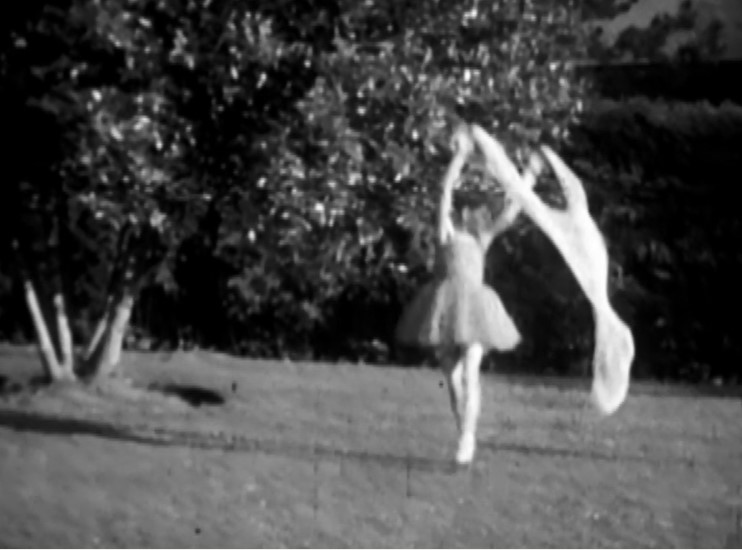
The Allan H. DeWolf fonds (PR-1792), comprising films, photographs and textual records, was donated to the BC Archives in 1985 by Gladys (DeWolf) Malach and her husband Peter Malach.
==========
* In what has become an obligatory footnote to Le Repas de Bébé, it should be remembered that Andrée Lumière, its infant star, died in 1918 at the age of 24, a victim of the Influenza Pandemic.

 Seriously Moving Images
Leave a comment