An essay in memory of Stan Fox.
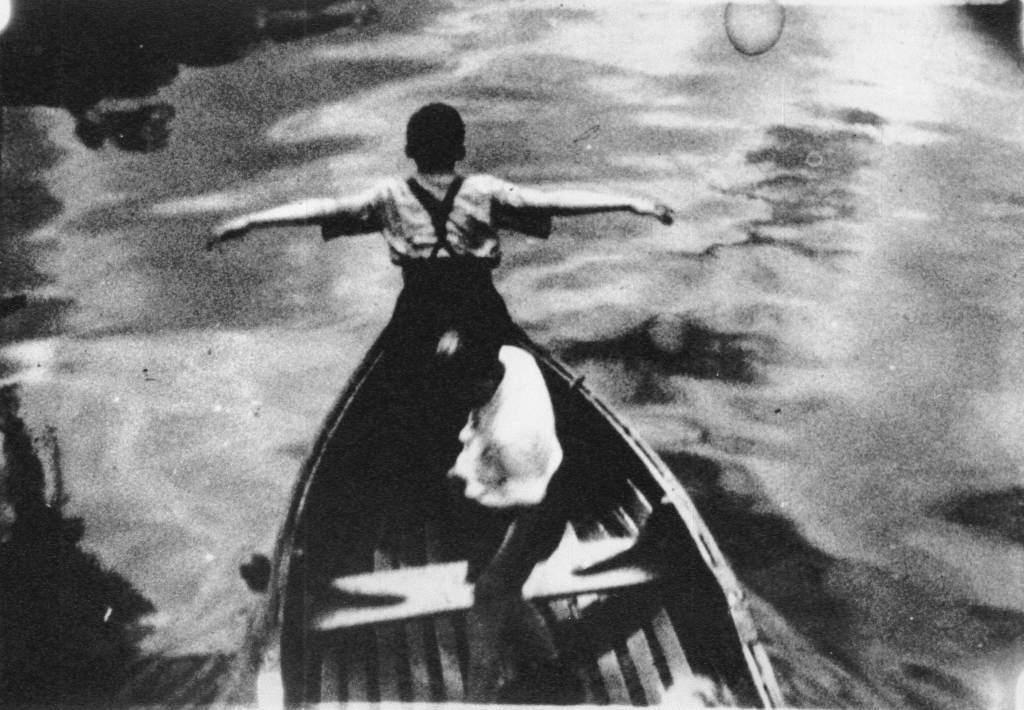
In the 1920s and 1930s, several European avant-garde filmmakers — inspired by the complex rhythms of urban life — created the so-called “city symphonies.” This important group of documentary films included Alberto Cavalcanti’s Rien que les Heures (1926), Walter Ruttman’s Berlin, Symphony of a Great City (1927), Dziga Vertov’s The Man With a Movie Camera (1928), Joris Ivens’ Rain (1929), and Arne Sucksdorff’s Rhythm of a City (1947). These films shared an impressionistic style; an interest in relationships of time and space; and an appreciation of abstract form, pattern and repetition. They also represented a significant cross-fertilization of cinema with the visual arts and music. The label of “city symphonies” very aptly suggests the “musical” structure of these films — their division into “movements” of varying themes and tempos, their use of recurring images and motifs to provide continuity.1
Interest in city symphonies was revived after the Second World War. In 1949 Vancouver, UBC student and film buff Stanley Fox (1928-2025) joined forces with Peter Varley (1921-2000), an art student and photographer influenced by John Vanderpant. They decided to make a documentary film about a day in the life of their city. As Fox recalled: “I found a partner in the person of Peter Varley, whom I had met years before at the film society. Peter understood what I wanted to do and we became co-creators. Then I started filming Vancouver. Not the tourists’ Vancouver, but the places and people that affected me emotionally: the downtown back alleys, Chinatown, the beaches that I played on as a child, the forgotten men on Main Street. I wanted it set on a summer Sunday when people were more open.”2
In the Daytime was the first (and only) production to be officially sponsored by the National Film Society (Vancouver Branch). The modest extent of this sponsorship (the film’s total budget of 60 dollars) is surprising, considering the result: a half-hour impressionist portrait of city life, with an integrated soundtrack of narration and classical music. Fox and Varley shot the film on comparatively “slow” (or insensitive) print stock that they painstakingly hand-processed. Varley edited the film; Fox assembled a musical score from selections on classical records; and writer Norman Newton provided a poetic commentary, which was read by UBC English professor Roy Daniells. Technically flawed but artistically brilliant, In the Daytime stands as the first fully-realized noncommercial film produced in Vancouver.
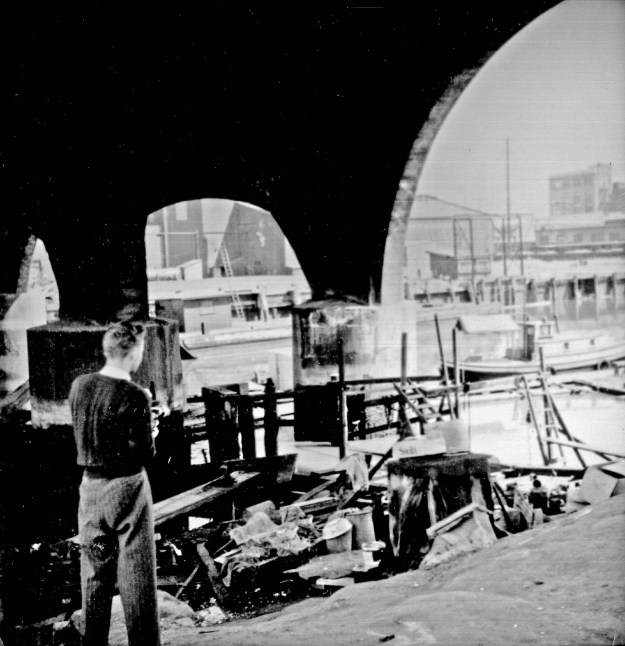
It is also distinguished by a novel approach to its subject. Rather than promote or describe “Vancouver” (as have countless sponsored films from World War One onward), In the Daytime explores “a city” and watches city-dwellers at leisure, revealing both in a series of well-observed episodes. Since the film is not intended to “sell” the image of a specific city, it is freed to speak to the viewer in a less obvious, more complex manner. The commentary — sometimes effectively atmospheric, sometimes witty, sometimes embarrassingly coy — is ultimately gratuitous. As a sound film, In the Daytime works best in its passages without commentary, where the filmmakers’ careful observation of pattern and movement is supported by well-chosen music. On an interurban streetcar rushing into town, commuters sit in solitary reverie as the tracks and scenery pour past the windows. Visiting Chinatown, the camera peers through gratings, looks over the shoulders of men reading posted copy from the Chinese Times, and glides along the street behind pedestrians.
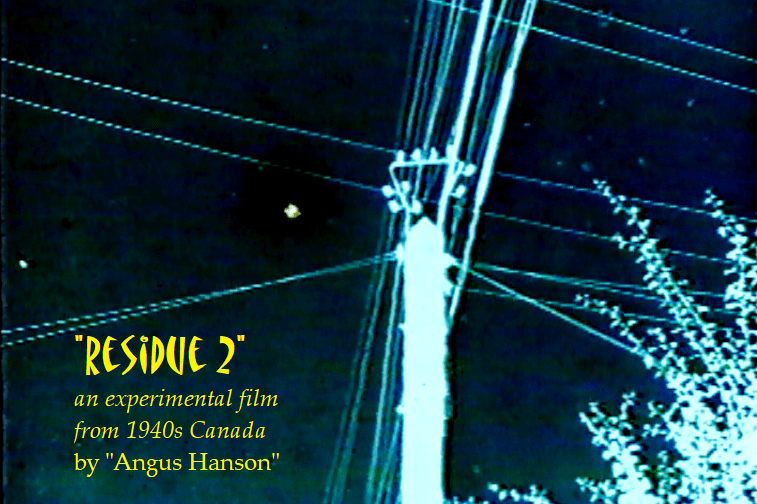
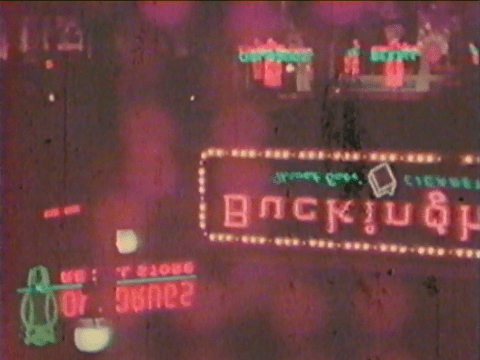
In the morning, the waterfront and empty streets are bathed in soft light; in late afternoon, the sidewalks are filled with shadowy tableaux, and the bevelled panes of a shop window fragment the passing traffic like a kaleidoscope. Finally, negative stock is used to depict nighttime traffic at the intersection of Hastings and Main, then the hub of downtown Vancouver.
As another city symphony, In the Daytime bears some resemblance to its forebears. The streetcar sequence, for instance, recalls the dynamic railway journey into the city that opens Ruttman’s Berlin. But Ruttman had utilized a whole range of camera and editing tricks, using the urban setting as a framework for his formalistic explorations; Cavalcanti’s Rien que les heures had employed a melodramatic subplot with fictional characters. The limited resources available to Fox and Varley ruled out such devices, forcing them towards a simpler technique.3 As a result, In the Daytime achieves a more congenial synthesis between its structure and its sociological interests. The people in the film are seen not as a homogeneous mass, but as individuals; not as features of the city, but as the city’s reason for being.
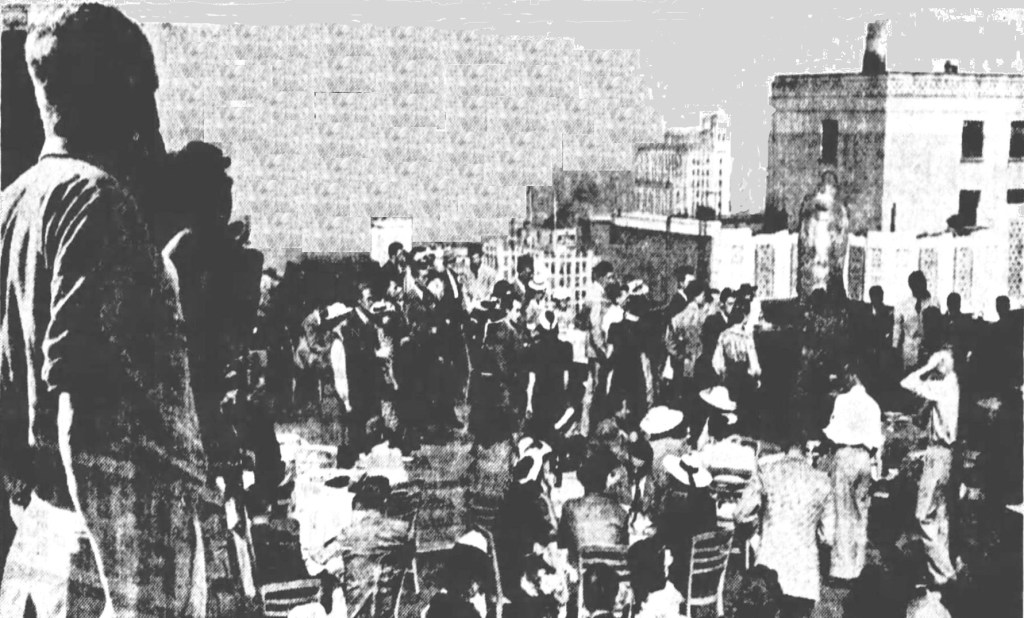
The National Film Society (Vancouver Branch) presented the premiere of In the Daytime on February 12, 1950, at the Manhattan Hall on West Broadway. Clyde Gilmour, film editor for the Vancouver Sun, helped promote the screening.
“In the Daytime” is described in an NFS statement as “a synthesis of the visually poetic elements of a ‘day off’ in the summertime, made with the intention of capturing the atmosphere of our city in one of its most pleasant aspects.
“It is not intended to be “a travelogue in the conventional sense,” but rather a film “that would catch certain typical individuals in their charming, silly, or vulgar states of nature.
”Yet the whole thing,” says the film society, “was designed to have a form and unity, like a piece of music.”4
Fox and Varley submitted their film to the 2nd Canadian Film Awards a month later in 1950. In the Daytime received honourable mention in the amateur category, behind the winning film in the category–Mouvement perpétuel by Montrealer Claude Jutra.
In 1985, Stanley Fox donated the original edited picture and soundtrack of In the Daytime to the British Columbia Archives, where it was restored under the supervision of archivist Dennis J. Duffy. The restored version premiered at National Film Week ’86 in Vancouver. It has since been screened several times at film festivals in Vancouver and Victoria. In the Daytime is now considered a key work in the history of BC filmmaking,

Stanley Fox passed away on May 20, 2025 at the age of 97. This CHEK-TV/Royal BC Museum video feature discusses at his lifelong fascination with film and photography. https://www.youtube.com/watch?v=aGJ9VFlZmLA
NOTES:
- Paul Rotha, Documentary Film (London: Faber & Faber, 1936; 3rd ed., 1952), pp. 85-87; Richard Meran Barsam, Nonfiction Film: A Critical History (New York: E.P. Dutton & Co., 1973), pp. 27-32; Erik Barnouw, Documentary: A History of the Non-Fiction Film (New York: Oxford University Press, 1974), pp. 73-77. ↩︎
- Stanley Fox, “Notes on My Cinema,” unpublished manuscript, Feb. 9, 2012. ↩︎
- Another Canadian-made “city symphony” of interest is Gordon Sparling’s Rhapsody in Two Languages (Associated Screen News, 1934), a theatrical short that used an array of cinematic effects to depict a day in the life of Montreal. ↩︎
- Clyde Gilmour, “Vancouver-Made Film Gets Premiere Sunday,” Vancouver Sun, Feb. 11, 1950, p. 17. ↩︎


 Seriously Moving Images
Leave a comment