
This house at 1960 Robson Street stood near the northwest end of Robson in Vancouver’s West End. It was just a block away from Lost Lagoon in Stanley Park.
Dorothy and Oscar Burritt lived in an apartment in this house from 1945 to 1947, before they moved to Toronto to begin the next phase of their lives. They lived in suite 2, and the “cedar panelled billiard room” was their living room.
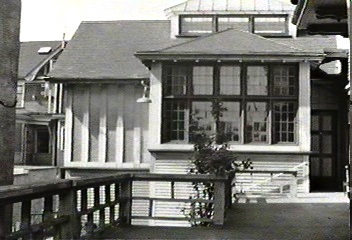
Suite 2 occupied the section of an old Robson Street mansion that had formerly been the billiard room. This obviously provided a large living room–excellent for screening films, entertaining, having dances–or making films.
Oscar mentioned that, in the hallway adjoining their apartment, [there] was a large walk-in refrigerator that also had a substantial freezer section. Oscar reported that this latter was ideally suited to the preparation of concentrated applejack. You simply put the bottle of commercial applejack in the freezer; in the morning, you poured off the liquid that remained unfrozen and there you were! — Douglas S. Wilson2
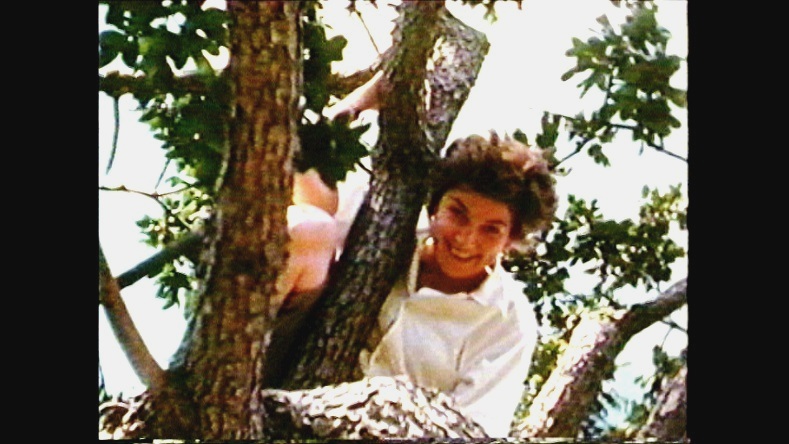
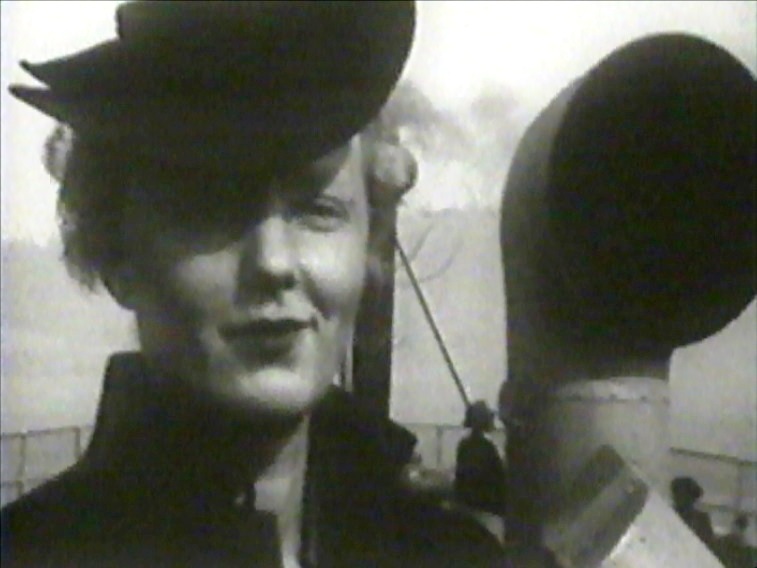
The Burritts were a pair of film enthusiasts, culture vultures, and talented filmmakers. Oscar (1908-1974) was a cinematographer, director, and editor for Vancouver Motion Pictures (VMP), the city’s leading film production company, which was owned by Leon C. Shelly.
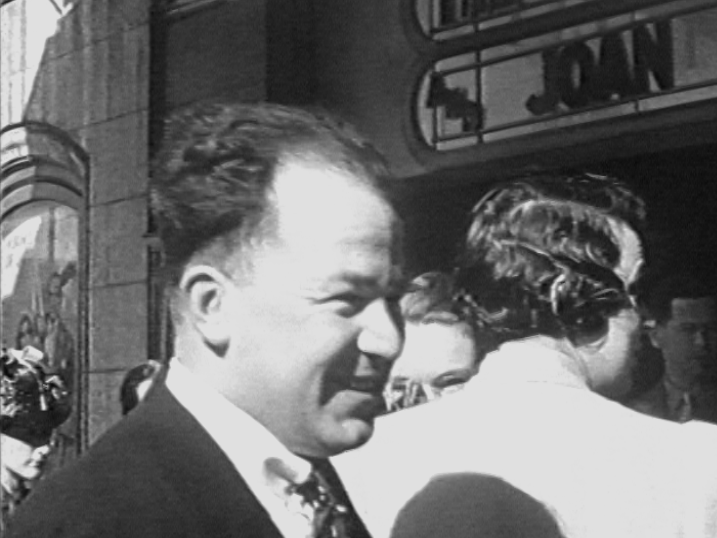
14 April 1940. (Digital frame grab)
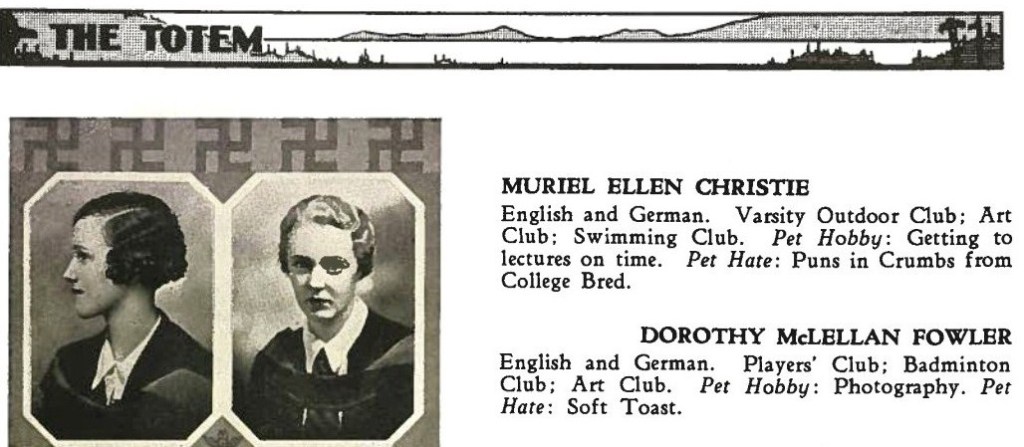
Dorothy (1910-1963) was very active in the National Film Society of Canada (Vancouver Branch).
She was very interested in film as well. . . . She was something of an “artiste” in her own way. She was interested in arty things, arty groups, discussions on philosophy and all that sort of thing. A good running-mate for Oscar. — Lew Parry, 19813
In June 1947, Dorothy made her most-fully-realized amateur film—Suite Two: A Memo to Oscar, an offbeat study of light and life at their beloved apartment. Leon Shelly had decided to move the VMP operation to Toronto, where it would become Shelley Films. Oscar went east to help set up the company’s facilities there.
Dorothy, who remained behind temporarily in Vancouver, conceived Suite Two as a present for her homesick husband. The film transcends its simple objective, and provides an fascinating glimpse of a unique milieu. Dorothy directed the film, which was photographed by 19-year-old Stanley Fox, another film society member. As Stan recalled in 1988:
Well, this was really Dorothy’s film. She had thought it up as a memento of her apartment and a present for Oscar—and a recording of those friends, y’know, at that time—and asked me if I would film it. That’s really how it happened. . . . It was her idea to make Suite Two as a kind of a memento of this apartment, which was going to be destroyed. In those days, they were just beginning to destroy the West End; and it was slated to go, to be replaced with an apartment house. That’s why the film was made.4
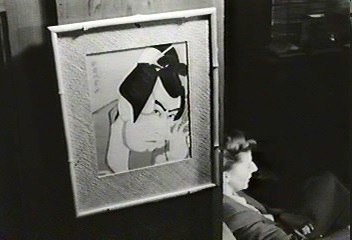
Suite Two is not what you might expect from a “home movie.” Entering through a window, the roving camera watches Dorothy arise, brush her hair, tidy the apartment, drink coffee, and sit for a formal portrait.
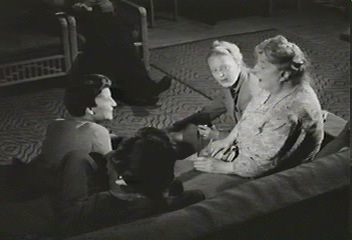
In the evening, several friends (including film librarian Moira Armour, film editor Maureen Balfe,5 local clairvoyant Nettie Gendall, and photographer Peter Varley) drop in for drinks, dancing, spirited conversation, and the screening of a French feature film: Sacha Guitry’s period comedy The Pearls of the Crown (1937), projected by the young Stan Fox.

Refreshments are served by Dorothy’s “butler”: an enigmatic figure in a bird costume that resembles a grotesquely Moderne-styled forerunner of “Big Bird.” This was Bob Allar’s award-winning costume from that year’s Picasso-themed Beaux Arts Ball, an annual celebration staged by students from the Vancouver School of Art.6
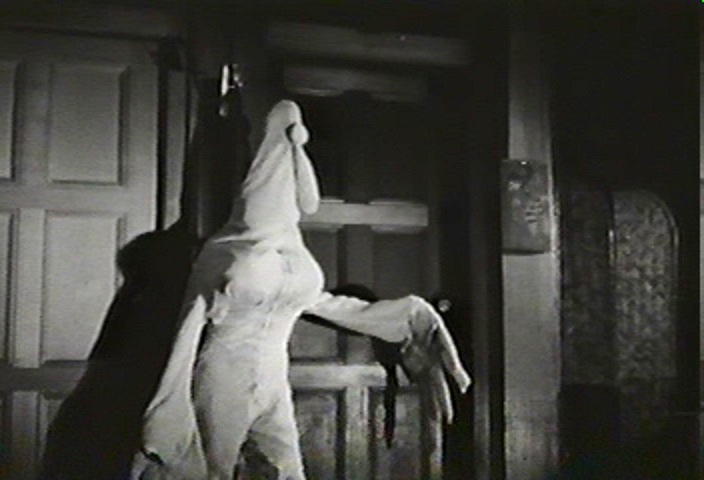
The most intimate of the Burritts’ films (essentially made for an audience of one), Suite Two is the most satisfying as well. Its modest objective—to depict a person, a living space, and circle of friends—is so charmingly achieved that the film fascinates complete strangers almost 80 years later. Due to its very specificity (recording this particular person, this room, these treasures, and this gathering), the film achieves a degree of “universality.” We can only envy the Burritts the pleasure they took in their friends, and enjoy the spirit in which the film captures it.
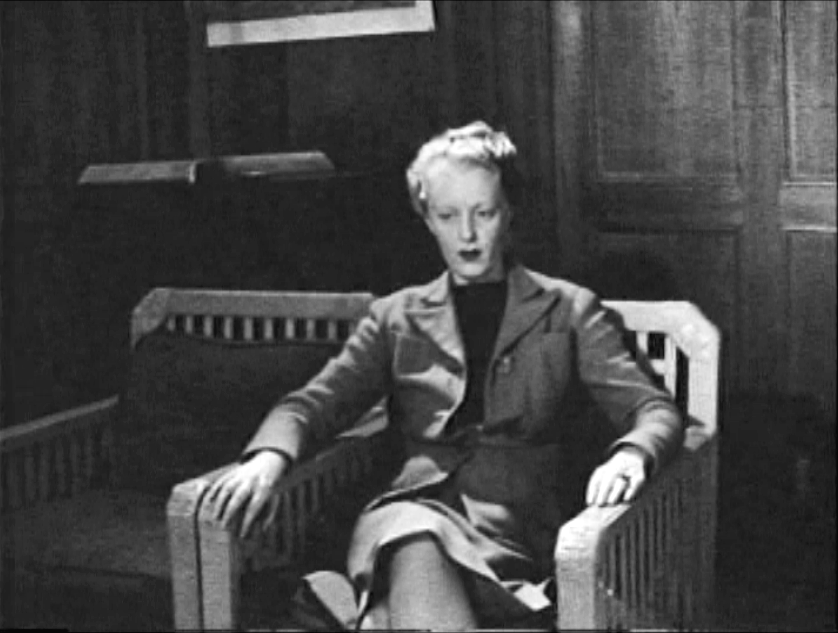
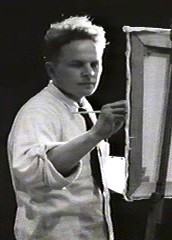
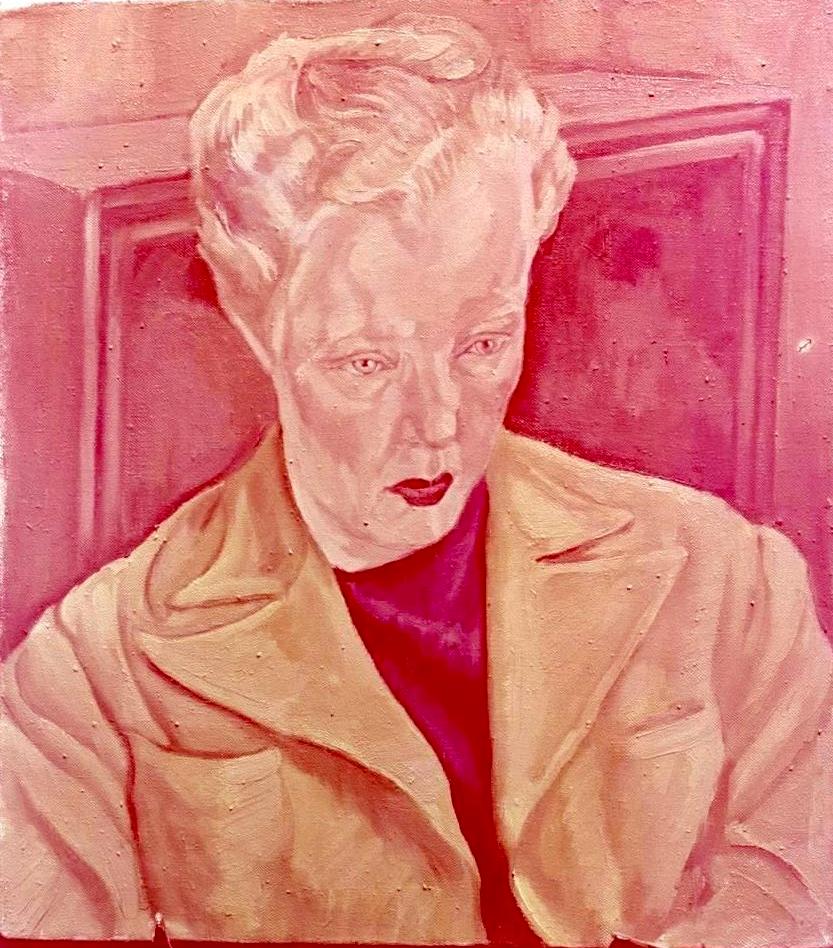
In an interlude before the party, artist Peter Bortkus (1906-1995) is shown painting Dorothy’s portrait. Born in Tallinn, Estonia, Bortkus was active during the years 1930-47 in Vancouver, where he was befriended and influenced by Peter Varley’s father—painter Frederick Varley (1881-1969), a member of the Group of Seven. By contrast, Bortkus was a little-known figure; he painted prolifically, especially in the field of portraiture, but his work was not exhibited to any significant degree. In 1947, he relocated to Toronto, where he supported his family by working as a commercial artist. The original Bortkus painting of Dorothy has since disappeared.7 In 1990, however, Douglas S. Wilson, a Toronto friend of the Burritts, was able to provide the BC Archives with a colour photograph of the painting.

When asked four decades later for his own assessment of Suite Two, Stan Fox replied:
Oh, I like it. I’m surprised. I think it’s a very interesting piece of film, in its way. As you say, the atmosphere is very charming, and seems to have lasted; it says something about the era, you know. I think people here in BC are particularly vulnerable to forgetting the past, or else looking at the past as being just a very quaint thing—something that was definitely not as sophisticated as the present.8
Suite Two received Honourable Mention in the amateur category at the very first Canadian Film Awards presentation in 1949.9 Decades later, the celebrated Canadian filmmaker Allan King (1930-2009) remembered Dorothy Burritt as “a remarkable heroine of film culture in Canada.”10
The original edited picture roll of Suite Two is preserved at the BC Archives, Royal BC Museum.11
This excerpt from Suite Two shows Dorothy Burritt hanging out and preparing for company in her Vancouver apartment.
NOTES:
- “1960 Robson.” WestEndVancouver: Vancouver West End history. [2013-17.] ↩︎
- Douglas S. Wilson: letters to Dennis Duffy, 17 January 1986, and to Allen Specht, 25 January 1986. ↩︎
- Lew Parry, interviewed by David Mattison, West Vancouver, 11 June 1981: audio tape no. T3855:0004, BC Archives, RBCM. ↩︎
- Stan Fox, interviewed by D.J. Duffy, Victoria, 20 June 1988: audio tape no. T4349:0003, BC Archives, RBCM. Ultimately, the house at 1960 Robson wasn’t demolished until March 1959. ↩︎
- For information about Moira Armour and Maureen Balfe, see the endnotes for my blog post “When Oscar Came Home” (1946/2025): Vancouver film types visit Galiano. ↩︎
- Stan Fox, personal communication. See John Mackie, “Partying at the Commodore with the Motifs Picasso and Jack Shadbolt,” Vancouver Sun, 25 July 2019. ↩︎
- If the painting still exists, the current owner may not be aware of the subject’s name, or of her significance to Canadian film culture. ↩︎
- Fox, 1988 interview. ↩︎
- Jack Karr, “Showplace: 29 Films Entered.” Toronto Star, 30 March 1949, p. 13. ↩︎
- Allan King, “Apprenticeship,” Canadian Film Encyclopedia, Toronto International Film Festival, 2002. (Online essay.) King, another film society member, was a lifelong friend of Stan Fox. ↩︎
- The original edited picture roll of Suite Two: A Memo to Oscar, donated by Stan Fox in 1985, is BC Archives item F1986:06. ↩︎


 Seriously Moving Images
Leave a comment