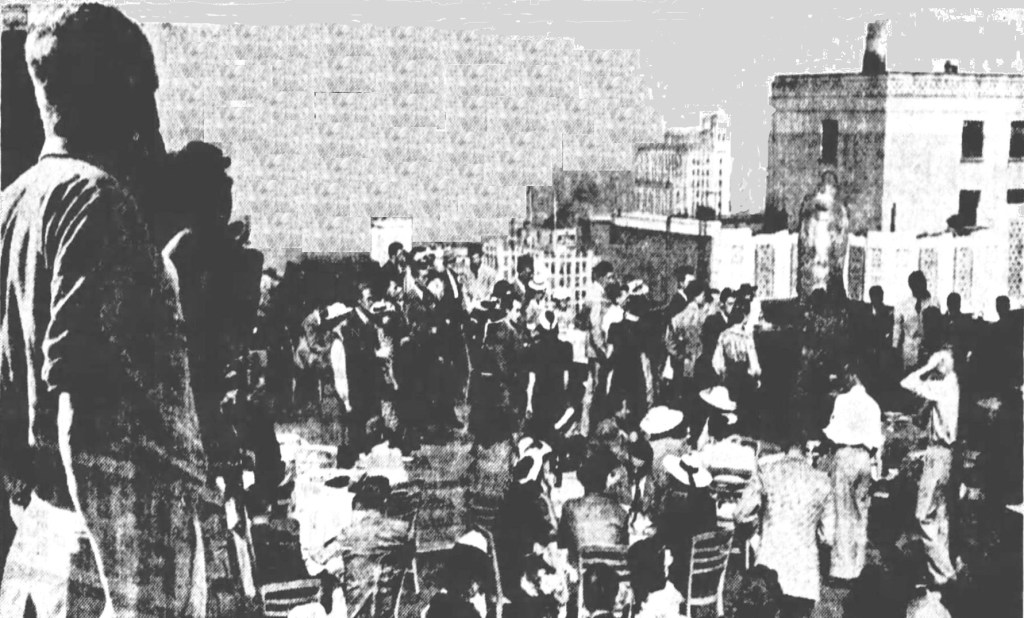
The above video clip comprises 8-millimetre amateur footage from August 7, 1940. It shows a second-unit team from Ortus Films shooting scenes in Vancouver for the 1941 British feature film 49th Parallel (released in the US as The Invaders). The amateur footage was shot by Vancouver actor Jack Bowdery, who probably worked as an extra in the local scenes.
49th Parallel was a wartime action/propaganda film highlighting Canada’s role in the Commonwealth during the early years of the Second World War. The film was produced and directed by Michael Powell and written by Emeric Pressburger, a pairing later famous as “The Archers” — the foremost creative team in British cinematic history.2
As 49th Parallel begins, a German U-boat torpedoes a Canadian tanker in the Gulf of St. Lawrence. The submarine takes refuge in Hudson Bay, where it’s destroyed by RCAF bombers. The surviving members of the U-boat crew attempt to escape cross-country to the Pacific Coast, or by crossing the Canadian border into the (then-neutral) United States. During their trek, the Nazi sailors encounter individuals and communities that embody democratic ideals: a French-Canadian fur trapper (and his Inuk guide) at an HBC trading post; a German Hutterite farming colony; Indigenous horsemen at Banff’s Indian Days; a British intellectual and art-lover avoiding the war; and a disgruntled Canadian soldier about to go AWOL.
The film’s leading players included Laurence Olivier, Anton Walbrook, Leslie Howard, Raymond Massey, Eric Portman, and Elisabeth Bergner (later replaced by Glynis Johns). However, none of the stars were present for the Vancouver filming. Most of the interior scenes in which they appeared were shot at Denham Film Studios in Buckinghamshire, England.
49th Parallel: Jack Bowdery’s 8mm behind-the-scenes footage
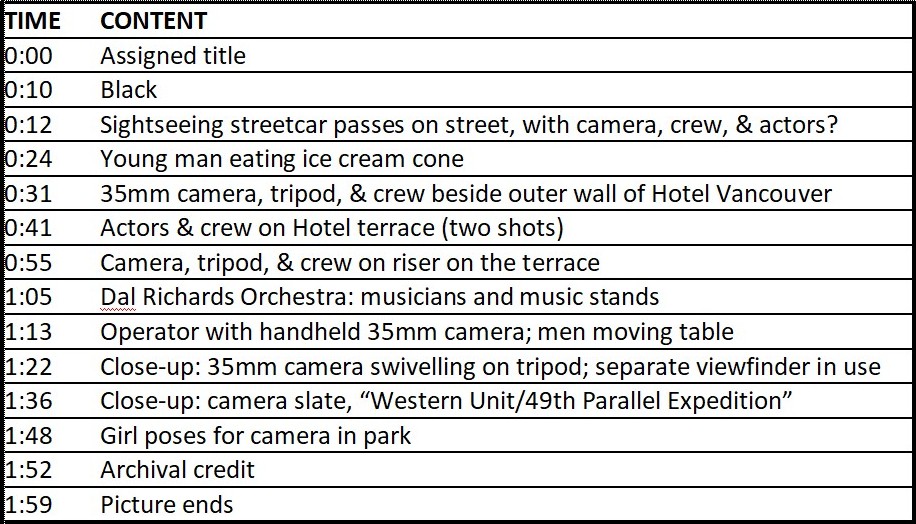
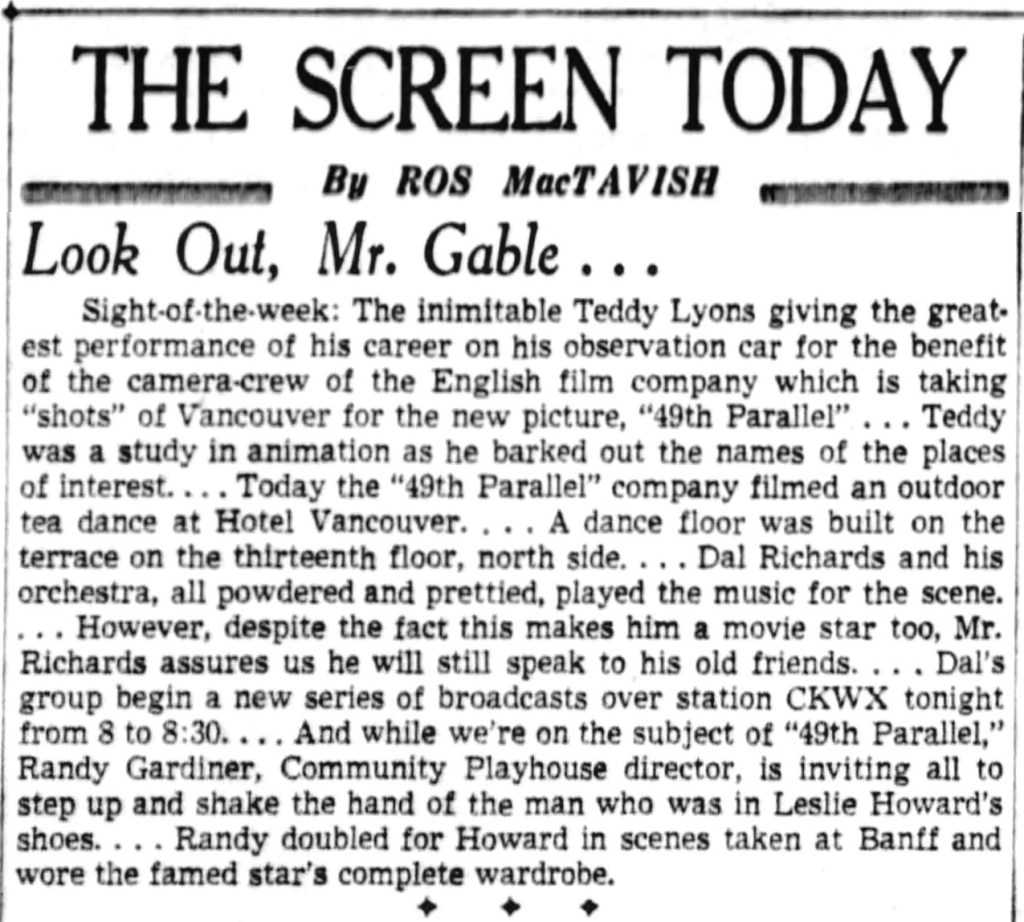
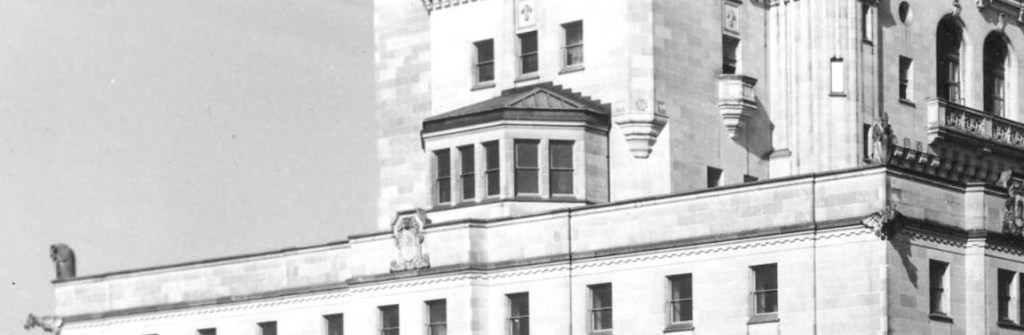
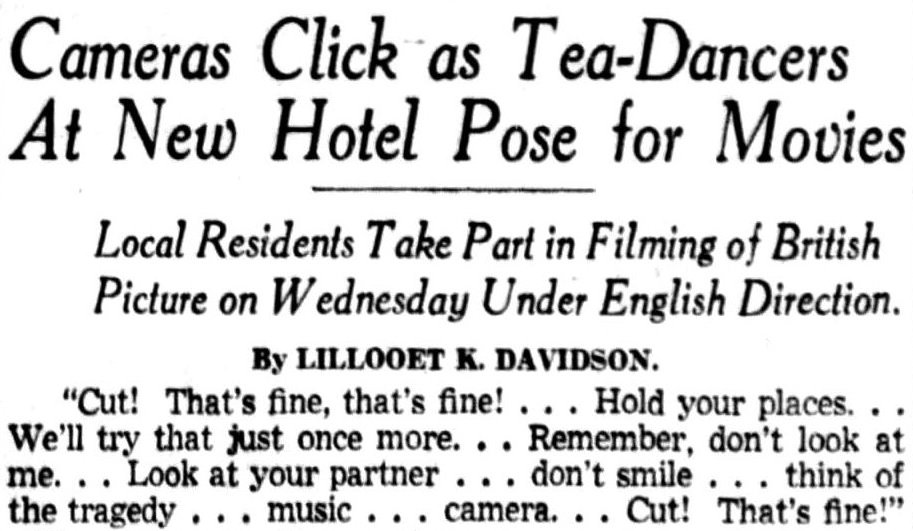
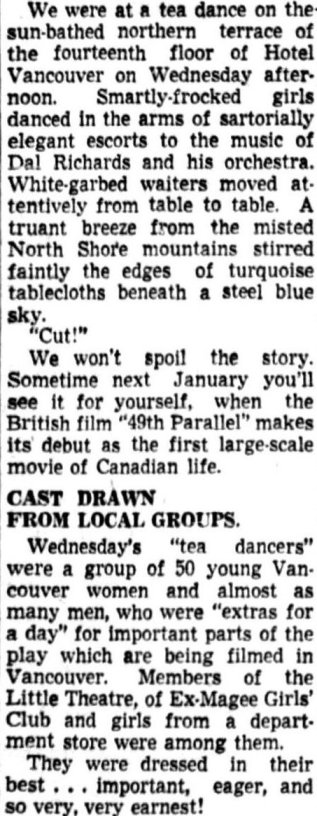
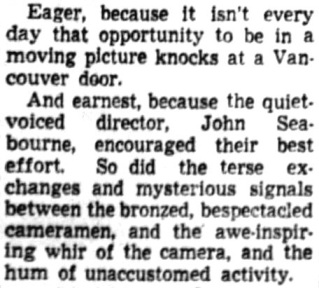
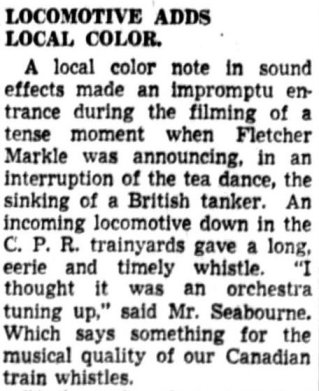
The Ortus Films crew was in Vancouver from July 30 to about August 10, 1940. The Vancouver sequences were filmed by associate director John (or Arthur) Seabourne3 and second-unit cameraman Osmond Borradaile.4 The footage shot comprised transitional scenes for use throughout the film. One key sequence was filmed on the 14th-floor outdoor terrace of the Hotel Vancouver, where a tea dance is interrupted by a radio news report about the sinking of the tanker. (Music for dancing is provided by Vancouver’s own Dal Richards Orchestra.)
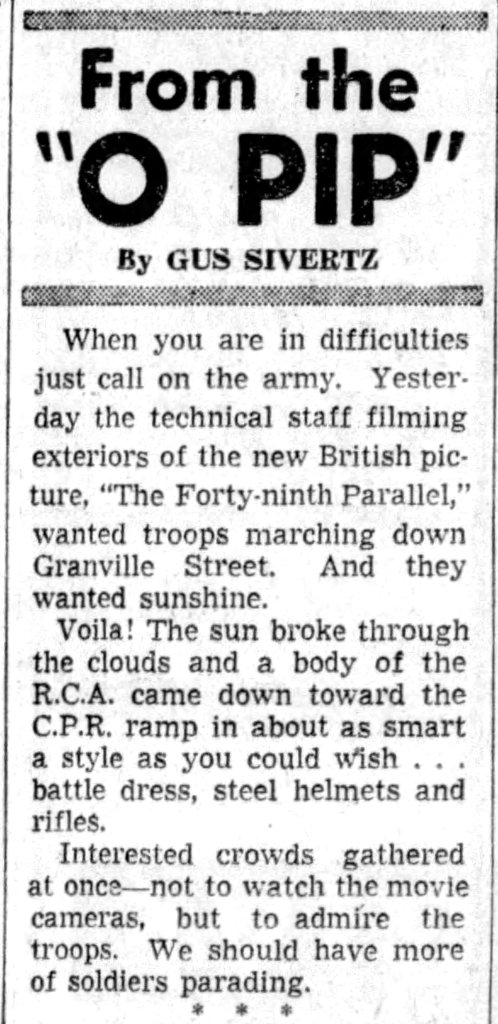
Other scenes shot nearby featured an open-topped streetcar (an BC Electric sightseeing car, with well-known conductor Teddy Lyons) and local troops marching down Granville Street.
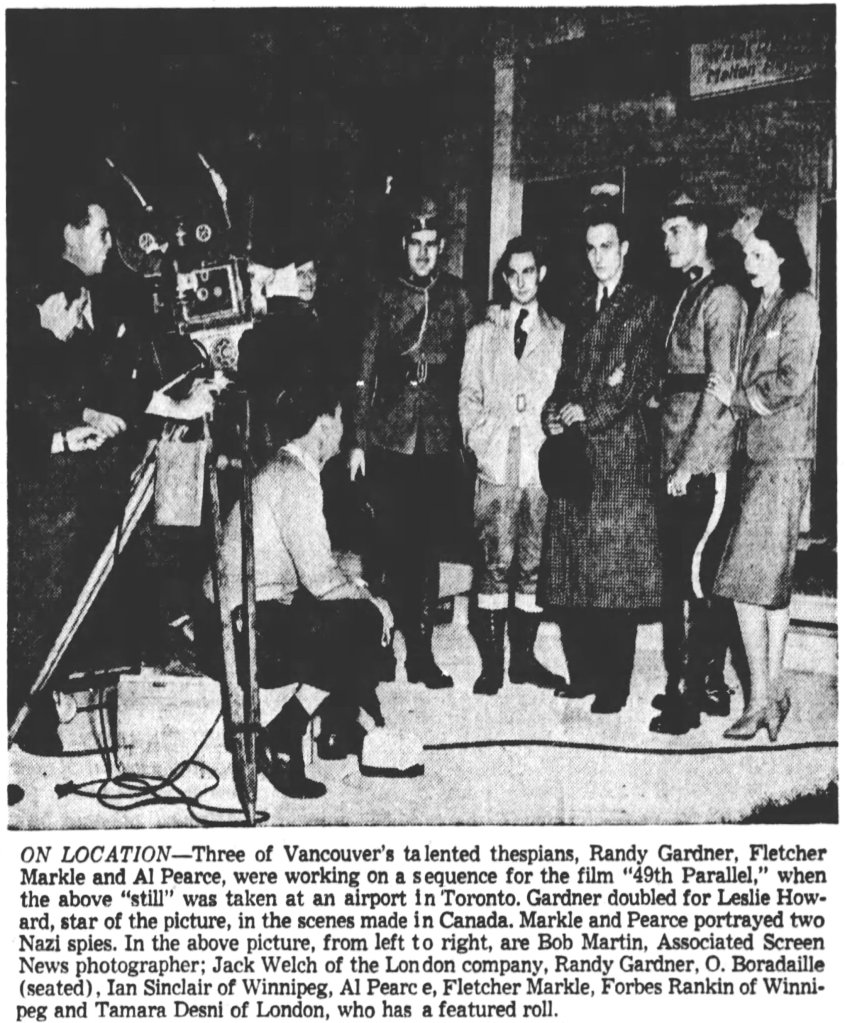
Some of the Vancouver actors or bit players were also employed in scenes shot elsewhere, where they “doubled” for leading cast members in long shots. Radio and stage actors Fletcher Markle and Alan Pearce doubled for two members of the U-boat crew, while Randy Gardner stood-in for star Leslie Howard.
We’re in the Movies Now!
| No, that wasn’t a real tea-dance in progress on the roof of Hotel Vancouver Wednesday afternoon. There was no tea in the tea cups, “no petits fours” on the silver cake dishes, the ginger ale bottles were “empties.” It was all just “make-believe” for the filming of a sequence for “49th Parallel,” a dramatic story of spy rings in Canada with Leslie Howard and Elisabeth Bergner in leading roles. Sequences are being filmed all across the Dominion. Director John Seabourne and his camera crew manoeuvred 150 smartly-dressed young Vancouverites for hours in yesterday’s brilliant sun atop the hotel roof. Dal Richards and his orchestra were part of the scene and some of the movie “extras” were asked to dance while others sat at tables and talked. They are supposed to depict Vancouver’s reaction when news is broadcast that a Nazi submarine has torpedoed a Canadian tanker in the St. Lawrence, bringing the war to Canada’s shores. Similar scenes are being shot in all the principal cities across the Dominion. |
Vancouver Sun, 8 August 1940, p. 6.

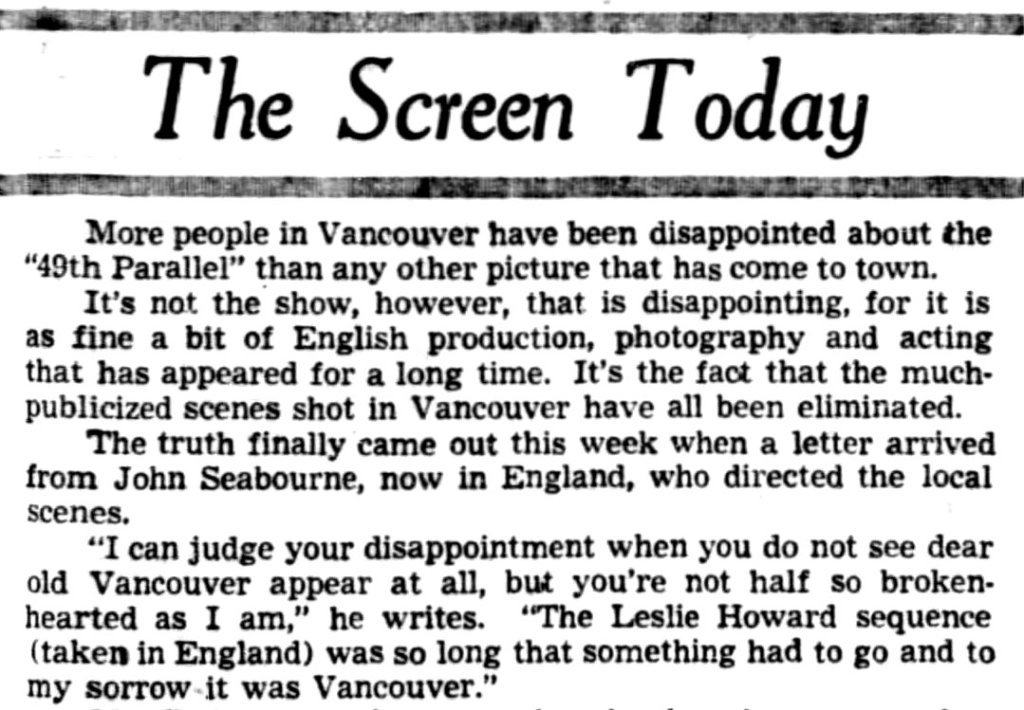
When it came time for David Lean to edit the film,5 it was clear that the script was too long, and some scenes had to be sacrificed. All the scenes shot in Vancouver wound up on the cutting room floor.6 (Jack Bowdery’s amateur footage may be all that survives from the shoot.)
Emeric Pressburger received two 1942 Academy Award nominations (Best Original Story and Best Screenplay) for his work on The Invaders [the US release], and shared with Powell another Best Screenplay nomination for The Archers’ One of Our Aircraft is Missing (1942). Pressburger won the Best Original Story Oscar for The Invaders.7 The film was one of ten nominees for Best Picture, losing to Mrs. Miniver.
On 29 January 1942, 49th Parallel opened to enthusiastic audiences at Vancouver’s Vogue Theatre. Eighteen months after John Seabourne and the Ortus Films crew arrived in town, Vancouverites were finally able to see the stirring and patriotic film — in which their city did not appear.

NOTES
- “Kura” by Maarten Schellekens (evocativesoundtrack.com), used under a CC-BY license from FreeMusicArchive. ↩︎
- The Archers’ best-known works include The Life and Death of Colonel Blimp (1943), I know Where I’m Going! (1945), A Matter of Life and Death [aka Stairway to Heaven] (1946), Black Narcissus (1947), The Red Shoes (1948), and The Tales of Hoffman (1951). ↩︎
- John (or Arthur) Seabourne, primarily a film editor, had a long association with Michael Powell. In 1931-32, Seabourne had edited several of Powell’s early pictures. In 1940-45, he edited five of the Powell-Pressburger films — but not 49th Parallel. ↩︎
- Winnipeg-born Osmond Borradaile (1898-1999) had been a camera operator in Hollywood before joining the British film industry in the early 1930s, working on a few classic films directed by Michael Powell. When the war began, Borradaile moved to British Columbia and lived near Vancouver. ↩︎
- Yes, that David Lean, who would direct Brief Encounter (1945), Great Expectations (1946), and Hobson’s Choice (1954), as well as the epics The Bridge on the River Kwai (1957), Lawrence of Arabia (1962), and Doctor Zhivago (1965). That guy. ↩︎
- Kevin Macdonald, Emeric Pressburger: The Life and Death of a Screenwriter (London: Faber and Faber, 1994; paperback ed., 1996), 176. ↩︎
- Macdonald, 203. ↩︎

 Seriously Moving Images
Leave a comment