In 1939, five Vancouver film enthusiasts joined forces under the name “Coast Films,” and produced a silent colour documentary on Stanley Park, Vancouver’s celebrated urban oasis. Directed by Malcolm C. Morrison, Stanley Park is a languid but lyrical look at flora and fauna, people at play, and the traffic of cars and ships in and around the park. Oscar Burritt shot the film with his friend Don Lytle, and their appreciation of light and pattern push Stanley Park beyond the limits of the conventional travelogue. Their use of vivid pre-war Kodachrome film stock also makes the picture stand out.
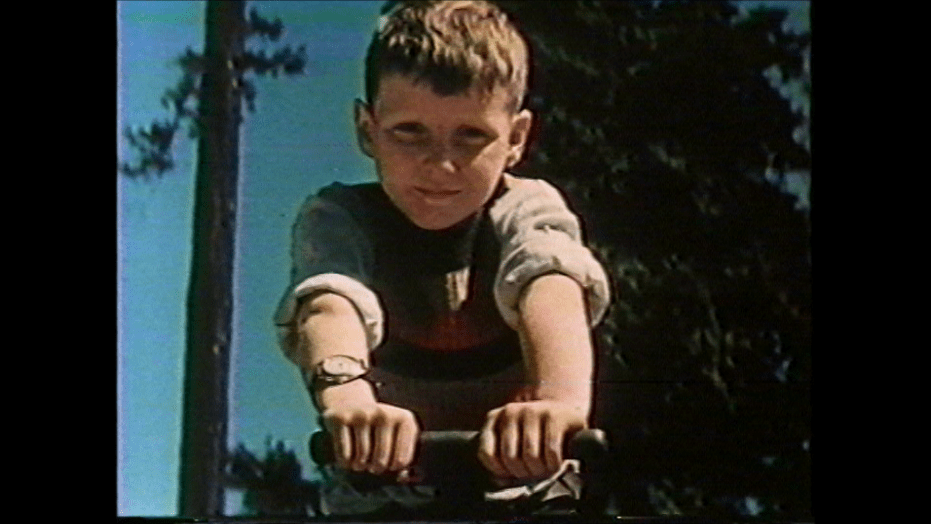
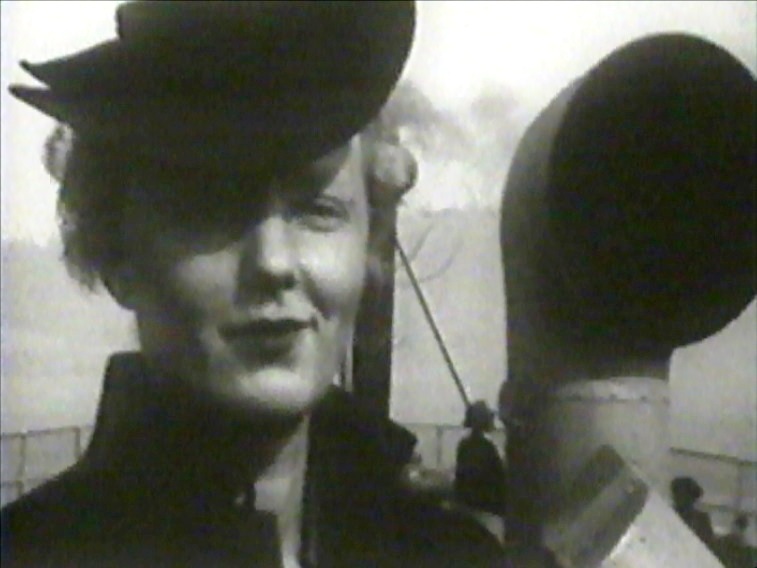
The excerpt shown here is the middle third of a 16-minute film [at 24 frames/second]. We see people arriving at the park on a weekend — by streetcar, by car, and on foot. The next sequence shows a very large audience watching a concert performance at Malkin Bowl. (The three young women on stage have probably just finished singing “Three Little Maids from School” from The Mikado.) There’s an engaging sequence of children playing on the swings and seesaws; then there’s footage of adults playing checkers and tennis, and another large crowd enjoying a cricket match. Scenes along the beach and the seawall (including the Second Beach Pool) lead into shots of boats and steamships sailing near First Narrows, and an ocean liner passing under the recently-completed Lion’s Gate Bridge. Charles Marega‘s handsome Art Deco stone lions, poised at the eastern approach to the bridge, are shown in close-up.
Stanley Park was a brave early effort at independent documentary production in Vancouver. The Coast Films group had intended to produce a series of films that could be distributed by the fledgling National Film Board of Canada, but the Second World War intervened, and this was their sole group effort.
However, Oscar Burritt’s (1908-1974) enthusiasm for the medium soon earned him a job as a cinematographer with Leon Shelly at Vancouver Motion Pictures, the primary local production company. Within a few years he was directing documentaries for Shelly.[i] In 1937, Don Lytle started freelancing as a film cameraman for Vancouver Motion Pictures and Fox Movietone News. He later worked for the NFB and eventually joined CBC Television when it opened its Vancouver station, CBUT, in 1953.
Of the other Coast Films members, James R. Pollock (1903-1989) was the Director of Visual Education for the Vancouver School Board. W. F. “Bill” Houston (1893-1981) was the Principal of Kerrisdale High School. Director Malcolm C. Morrison (1907-1985) was a Vancouver school teacher. A few years later, he started making “shadowgraphs,” using silhouettes to tell stories on film.
Stanley Park was restored in 1987 by the British Columbia Archives. The soundtrack for this excerpt combines two musical pieces by Maarten Schellekens of evocativesoundtrack.com.
[i] Oscar Burritt’s directorial credits at Vancouver Motion Pictures included Tomorrow’s Timber (1944) and Of Japanese Descent (1945), produced for the National Film Board, as well as The Herring Hunters and Salmon for Food (both 1945), made for British Columbia Packers Ltd.



 Seriously Moving Images
Leave a reply to bcfilmguy Cancel reply